

How Climate Affects Your Perfume’s Longevity

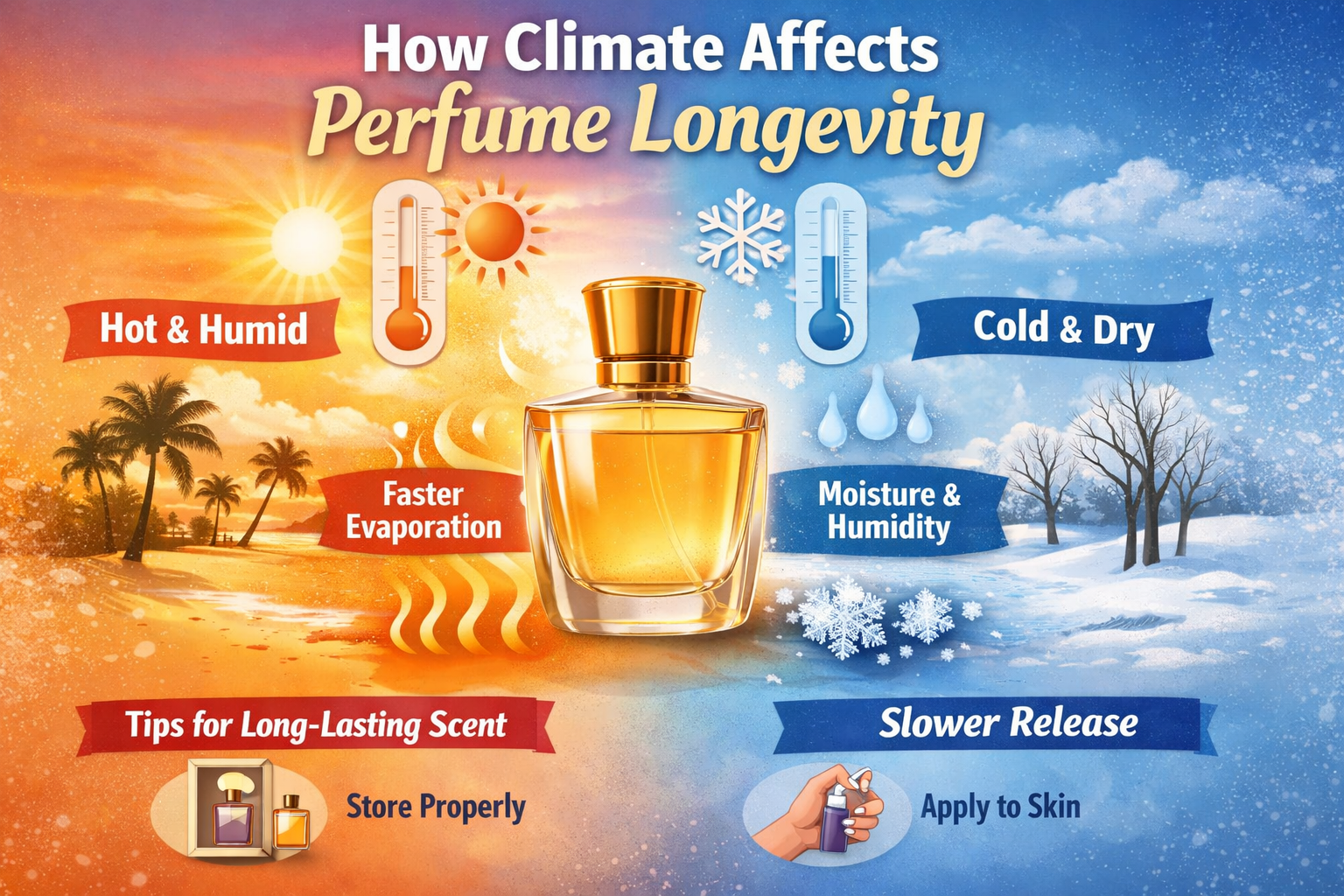
Climate plays a crucial role in determining how long your fragrance lasts throughout the day. Many people overlook how climate affects perfume longevity, focusing only on the scent itself rather than the environment around them. Factors such as heat, humidity, and cold weather can change how quickly a perfume evaporates or settles on your skin. By understanding how climate interacts with your fragrance, you can make better choices to ensure your perfume lasts longer and performs at its best.
Understanding Perfume Longevity
Before diving into climate effects, it’s important to understand what “longevity” means in perfumery. Longevity refers to how long a fragrance remains detectable after application. This depends on:
- The concentration of fragrance oils (e.g., parfum vs eau de toilette)
- The composition of notes (top, middle, base)
- Skin chemistry
- External factors especially climate
Perfumes evolve over time through three stages:
- Top Notes – Light, fresh scents that evaporate quickly
- Heart Notes – The core of the fragrance, lasting a few hours
- Base Notes – Deep, rich scents that linger the longest
Climate affects how quickly these layers evaporate and interact with your skin.
The Role of Temperature
1. Heat and High Temperatures
Hot weather is one of the biggest factors influencing perfume longevity.
Faster Evaporation
Heat accelerates evaporation, causing perfume molecules to break down more quickly. This means:
- Top notes disappear almost instantly
- Middle notes fade faster than usual
- Base notes may not fully develop
Increased Projection
While longevity decreases, projection (how far the scent travels) increases. Heat amplifies scent diffusion, making your fragrance more noticeable but for a shorter time.
Risk of Overpowering Scents
In high temperatures, strong fragrances (like oud, amber, or heavy florals) can become overwhelming or even unpleasant.
Best Choices for Hot Weather:
- Citrus-based fragrances
- Aquatic or marine scents
- Light florals
- Green or herbal notes
These compositions feel refreshing and are less likely to become cloying.
2. Cold Weather
Cold climates have the opposite effect on perfume.
Slower Evaporation
Low temperatures slow down the evaporation process, allowing fragrances to last longer. However, this also means:
- The scent develops more slowly
- Projection is reduced
Muted Scent Profile
Cold air suppresses diffusion, so fragrances may feel weaker or closer to the skin.
Ideal for Rich Scents
Winter is the perfect time to wear deeper, heavier fragrances because:
- They won’t feel overwhelming
- They last longer
- They unfold gradually
Best Choices for Cold Weather:
- Woody fragrances
- Spicy notes (cinnamon, clove)
- Oriental scents
- Gourmand fragrances (vanilla, chocolate, coffee)
The Impact of Humidity
Humidity refers to the amount of moisture in the air, and it has a powerful influence on how perfume behaves.
1. High Humidity
In humid climates, moisture in the air interacts with fragrance molecules.
Enhanced Longevity
Humidity slows evaporation, allowing scents to linger longer on the skin.
Amplified Intensity
Fragrances tend to project more in humid conditions, making them stronger.
Potential for Overpowering Effect
Because scent molecules stay suspended in moist air, strong perfumes can become too intense.
Tips for Humid Weather:
- Apply lightly
- Avoid heavy, dense fragrances
- Focus on fresh, breathable compositions
2. Low Humidity (Dry Air)
Dry climates can be harsh on perfume longevity.
Faster Absorption by Skin
Dry skin absorbs fragrance oils quickly, reducing longevity.
Reduced Projection
Without moisture in the air, scent molecules dissipate faster.
Fading Fragrance
Perfume may disappear sooner than expected, even if it’s high quality.
Tips for Dry Weather:
- Moisturize your skin before applying perfume
- Use oil-based or stronger concentrations
- Layer fragrances for better staying power
Wind and Airflow
Wind is another climate factor that often goes unnoticed.
How Wind Affects Perfume:
- Disperses scent quickly – Reduces longevity
- Interrupts scent trail – Makes fragrance less noticeable
- Breaks down layers faster – Alters scent development
In windy environments, even long-lasting perfumes may seem weak.
Solution:
- Apply perfume on pulse points covered by clothing
- Use slightly stronger fragrances to compensate
Sun Exposure and UV Rays
Sunlight can impact both your perfume and your skin.
On Your Skin:
UV rays can heat up your skin, increasing evaporation and reducing longevity.
On the Perfume Itself:
Direct sunlight can degrade fragrance molecules, altering the scent and reducing performance.
Important Tips:
- Avoid applying perfume directly before sun exposure
- Store perfumes in cool, dark places
- Don’t leave bottles in hot environments (like cars)
Skin and Climate Interaction
Climate doesn’t just affect perfume directly it also changes your skin.
In Hot Weather:
- Skin produces more oil and sweat
- Fragrance may mix with sweat, altering the scent
In Cold Weather:
- Skin becomes dry
- Perfume fades faster without proper hydration
In Dry Climates:
- Skin lacks moisture to hold fragrance
In Humid Climates:
- Skin retains moisture, helping fragrance last longer
Seasonal Fragrance Strategy
To maximize perfume longevity, it’s smart to adapt your fragrance wardrobe according to the seasons.
Summer
- Light, fresh scents
- Reapply throughout the day
- Focus on body mists or eau de toilette
Winter
- Rich, warm fragrances
- Fewer reapplications needed
- Choose parfum or eau de parfum
Spring
- Floral and green notes
- Balanced compositions
Autumn
- Spicy, woody scents
- Medium intensity fragrances
Practical Tips to Improve Longevity in Any Climate
Regardless of where you live, these strategies can help your perfume last longer:
1. Moisturize Your Skin
Hydrated skin holds fragrance better. Use unscented lotion before applying perfume.
2. Apply on Pulse Points
These include:
- Wrists
- Neck
- Behind ears
- Inner elbows
Pulse points emit heat, helping diffuse the fragrance.
3. Don’t Rub Your Wrists
Rubbing breaks down fragrance molecules and shortens longevity.
4. Layer Your Fragrance
Use matching:
- Body wash
- Lotion
- Perfume
This builds a longer-lasting scent profile.
5. Spray on Clothes (Carefully)
Fabric holds fragrance longer than skin, especially in dry climates.
6. Choose the Right Concentration
- Parfum – Longest lasting
- Eau de Parfum – Strong and balanced
- Eau de Toilette – Lighter, shorter-lasting
- Body Mist – Very light
Choosing the Right Perfume for Your Climate
Hot and Humid Regions
- Opt for light, airy fragrances
- Avoid heavy oils and strong musky scents
Hot and Dry Regions
- Use stronger concentrations
- Moisturize frequently
Cold and Dry Regions
- Go for rich, deep fragrances
- Layer scents for longevity
Mild Climates
- You have flexibility experiment with different styles
Common Mistakes to Avoid
- Using the same perfume year-round
Climate changes require fragrance adjustments - Over-applying in heat
Can lead to overwhelming scent - Ignoring skin hydration
Dry skin reduces longevity - Improper storage
Heat and sunlight damage perfumes - Expecting all perfumes to perform equally
Different compositions react differently to climate
Final Thoughts
Climate plays a crucial role in how your perfume performs. From temperature and humidity to wind and sun exposure, environmental factors can dramatically alter both longevity and projection.
By understanding these influences, you can:
- Choose the right fragrance for your environment
- Adjust your application technique
- Maximize the life of your scent
Ultimately, perfume is a personal experience but it’s also a scientific one. When you align your fragrance choices with your climate, you not only smell better you make your scent last longer and perform exactly as intended.
Whether you’re walking through a humid summer afternoon or enjoying a crisp winter evening, the right perfume strategy ensures your signature scent stays with you every step of the way.